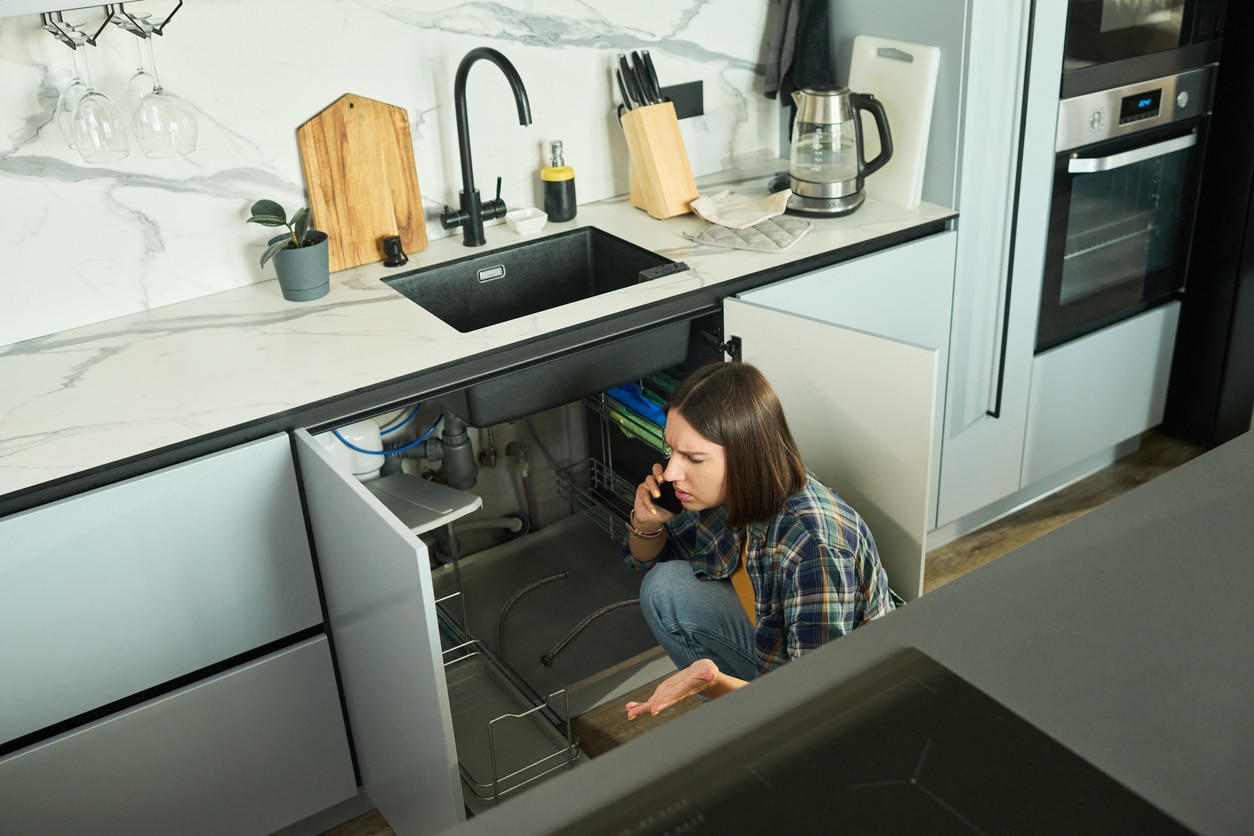
Most plumbing problems announce themselves quietly. A drain empties a little slower each week. The toilet runs for ten seconds after it refills. The hot water runs out sooner than it used to.
Then one Saturday the drain stops entirely, and what could have been a fifteen-minute fix turns into a weekend without a working bathroom.
Knowing how to read those early signals is worth real money. Some of these you can handle yourself in under an hour with tools you already own. Others need a licensed plumber, and a few need the water shut off before you do anything else. Here is how to tell them apart.
Start Here: Is This an Emergency or Can It Wait?
Before you troubleshoot anything, sort the problem into one of three buckets. This is the step almost everyone skips, and it’s the one that prevents most water damage.
Shut the water off right now if you see:
- Water actively spraying, pouring, or pooling from a pipe, connection, or appliance
- Water coming up through a floor drain or backing up in multiple fixtures at once
- A visibly bulging, dripping, or rusted water heater tank
- Any water near an electrical panel, outlet, or wiring
- Sewage odor with visible backup
Call the same day, but you are not in crisis:
- No hot water at all
- A single fixture backing up
- A leak you can catch in a bucket
- Water pressure that dropped suddenly across the whole house
It can wait until business hours:
- One slow drain
- A running toilet
- A dripping faucet
- Water that takes longer than usual to get hot
Knowing where your main shut-off is matters more than any other item on this list. FEMA’s home safety guidance recommends that responsible members of every household know how to turn off water at the main, and describes the valve as typically located in the water meter box where the main line enters the property, closed by turning it to the right. Many Metro Atlanta homes also have an interior shut-off near where the line enters the house, often in a basement, crawlspace, or garage.
Go find yours this week, while nothing is wrong. Turn it to confirm it actually works. A seized shut-off valve discovered during a burst pipe is its own emergency.
Slow and Clogged Drains
A slow drain is a partial clog, and partial clogs are the easiest plumbing problem to fix yourself if you approach them in the right order.
Work mechanically first, chemically never.
Step one: Clear what you can reach. In a bathroom sink or tub, the culprit is almost always hair and soap scum sitting within the first several inches. Pull the stopper assembly and clear it by hand or with a plastic barbed drain tool. This solves a large share of bathroom drain problems and costs a few dollars.
Step two: Hot water and dish soap. For a kitchen drain slowed by grease, very hot water and a squirt of degreasing dish soap can loosen the buildup. The EPA’s own guidance for households recommends boiling water or using a drain snake as an alternative to chemical drain openers.
Step three: Plunge it correctly. Most people plunge too gently and give up early. Seal the overflow opning with a wet rag first, or you are just moving air. Use firm, sustained strokes.
Step four: Use a hand auger. A 25-foot hand auger costs less than a service call and reaches clogs that a plunger cannot. Feed it slowly, and stop if you hit hard resistance you can’t work through.
If the clog is beyond that, or if it returns within weeks, the problem is not in the fixture. Recurring clogs in the same line usually mean buildup deeper in the branch, and multiple fixtures backing up at once point to the main sewer line. That’s when professional drain cleaning with a camera inspection tells you what is actually happening instead of guessing.
Why Chemical Drain Cleaners Are the Wrong Tool
They are the most-purchased plumbing product, but the one professionals recommend least, and the reasons are documented rather than promotional.
Most caustic drain openers rely on sodium hydroxide. The CDC’s NIOSH chemical guide lists it as corrosive to metals, specifically incompatible with aluminum, tin, and zinc, and notes that contact with water generates enough heat to ignite combustible materials. That heat is the problem in a pipe: it works on the clog and on everything around the clog, including older metal drain lines and PVC joints.
The safety issue is more immediate. The National Capital Poison Center documents that injury commonly occurs when drain cleaner splashes back from the drain, which happens when the product is poured from too high or when too much is poured into a fully blocked drain. Their guidance on caustics is blunt: chemical burns occur instantly on contact with skin or eyes, and the injury cannot be reversed, only treated.
The same source is worth citing on a popular home remedy. Baking soda and vinegar does not clear clogs, because the carbon dioxide escapes through the drain opening rather than building the pressure needed to move a blockage.
One practical note. If you have already poured chemical cleaner down a drain and it did not work, tell your plumber before they start. Standing caustic liquid in a trap is a hazard for whoever opens that line, and a professional will handle it differently if they know it’s there.
Running and Weak-Flushing Toilets
A running toilet is the cheapest expensive problem in your house. It causes no visible damage and quietly runs your water bill up every month.
The numbers are worth seeing. EPA WaterSense reports that the average household’s leaks account for more than 9,300 gallons wasted per year, and that nine percent of homes have leaks wasting 50 gallons or more per day. A single running toilet on its own can add as much as 200 gallons per day. Toilets account for 25 to 30 percent of household water use before anything goes wrong.
Diagnosing it takes ten minutes and a few drops of food coloring:
- Remove the tank lid and drop food coloring into the tank
- Do not flush
- Wait ten minutes
- Check the bowl
Color in the bowl means water is leaking past the flapper. University of Georgia Extension’s household water audit adds a useful refinement: if the tank water level stays the same during the test, the problem is the refill valve or float, and if it drops below the fill line, the problem is the flush valve or flapper.
Flapper replacement is genuinely a homeowner job. The part costs a few dollars, and EPA WaterSense recommends replacing flappers at least every five years as routine maintenance. If replacing the flapper doesn’t fix it, the flush valve seat may be pitted, or the fill valve may need replacement, and at that point, a service call is usually the better use of a Saturday.
A weak or incomplete flush is a different problem. That’s typically mineral buildup in the rim
jets or a partial blockage further down the line, and it often signals hard water. Metro Atlanta water is not the hardest in the country, but mineral buildup accumulates in fixtures and water heaters over years.
No Hot Water, or Not Enough
Start with the simple checks. On a gas heater, confirm the pilot or igniter is working. On an electric unit, check the breaker. A tripped breaker or a failed heating element are both common and both are diagnosable quickly.
Then check the temperature setting, and set it correctly while you are there. The Consumer Product Safety Commission urges households to set water heaters to 120 degrees Fahrenheit, and their scald data explains why. Most adults suffer third-degree burns after two seconds of exposure to 150-degree water, six seconds at 140 degrees, and thirty seconds at 130 degrees.
Even at 120 degrees, a five-minute exposure can cause third-degree burns.
If you are running out of hot water sooner than you used to, sediment buildup at the bottom of the tank is the usual cause. Sediment occupies volume that should hold water and insulates the burner from it.
The Water Heater Warning Signs to Never Ignore
Some water heater symptoms are maintenance items. These are not.
Water pooling under the tank. A leaking tank is failing and will not be repaired.
A dripping or discharging temperature and pressure relief valve. The T&P valve is the primary safety device on the appliance. InterNACHI explains the physics: superheated water released from a failed tank expands into steam almost instantly, occupying roughly 1,600 times its original volume, which is enough force to propel a tank through multiple floors.
Such failures are rare because they require several safety systems to fail at once, but a leaking T&P valve indicates the valve needs replacement rather than adjustment.
A capped or blocked T&P discharge pipe. HUD’s housing inspection standard rates obstructed discharge piping as a severe deficiency requiring correction within 24 hours. Never cap that line, and never let anyone else.
Rumbling or popping during heating, which indicates significant sediment.
Rusty hot water, which often means the tank’s interior is corroding.
If the tank is showing any of these, get eyes on it before it decides the timeline for you. Water heater service on a failing unit is far cheaper than the cleanup after one lets go.
Leaks You Cannot See
The leaks that cause the most damage are the ones behind walls and under slabs, and they announce themselves indirectly.
Watch for a water bill that climbed without a change in your household, the sound of running water when every fixture is off, warm spots on a floor, unexplained damp patches or musty odor, or a drop in water pressure across the whole house.
You can run a rough whole-house test yourself. Turn off every fixture and water-using appliance, then check the water meter. If the low-flow indicator is moving, water is going somewhere. Note the meter reading, wait an hour without using water, and check it again.
Finding it is a different matter. Slab and in-wall leaks need leak detection equipment rather than exploratory demolition, and the difference in repair cost is substantial.
Where the Line Is Between DIY and a Licensed Plumber
Georgia law is clearer on this than most homeowners expect, and it cuts both ways.
Under Georgia code, an individual may perform plumbing work on a residential dwelling they own or occupy, but that work must still conform to state regulations and to any applicable county or municipal ordinances, codes, and inspection requirements.
You are permitted to work on your own home. You are not exempt from code or from pulling a permit when one is required. Anyone performing plumbing work for compensation on someone else’s property must be licensed, and in Georgia, only a licensed Master Plumber may own a plumbing business.
Practically, here is the line we would draw:
Reasonable to handle yourself: clearing hair from a bathroom drain, plunging, running a hand auger, replacing a toilet flapper or fill valve, replacing a faucet aerator, replacing a supply hose, and insulating exposed pipes.
Call a professional: anything involving gas lines, water heater replacement or T&P valve work, sewer line issues, slab or in-wall leaks, repiping, backflow devices, main line problems, any work requiring a permit, and any situation where you cannot locate or reach the source.
One more from the American Red Cross on frozen pipes, since Metro Atlanta gets enough cold snaps for it to matter: if you cannot locate the frozen section, cannot reach it, or cannot thaw it, call a licensed plumber. And never use a blowtorch, kerosene or propane heater, charcoal stove, or any open flame to thaw a pipe.
A Few Questions We Get Often
How do I know if a clog is in the fixture or the main line?
If one fixture is affected, the clog is local. If multiple fixtures back up, or if using one fixture causes water to appear in another, the problem is in the main line and needs professional attention.
Is it worth buying a drain snake?
For most homeowners, yes. A basic 25-foot hand auger costs less than a service call and handles the majority of sink and tub clogs. Powered augers and hydro-jetting are where professional equipment earns its keep.
Why does my drain clog again a few weeks after I clear it?
Because you cleared the symptom rather than the buildup. A clog that returns on a schedule usually means accumulated grease, scale, or root intrusion further down the line, which a camera inspection will identify.
Fix the Small Things Before They Get a Vote
Almost every plumbing emergency has a quiet early version. The slow drain, the ten-second run after the flush, the hot water that fades a little faster each month. Handling those while they are small is the whole game, and most of them are genuinely within reach of a homeowner with a plunger, an auger, and an afternoon.
The rest is worth handing to someone who does it every day.
Not Sure Whether Yours is a DIY Job or a Call?
Serv’All Plumbing has served Metro Atlanta homeowners since 1995 with flat-rate upfront pricing, free second opinions, and no-obligation estimates. We work in Acworth, Kennesaw, Marietta, Roswell, Alpharetta, Canton, Dallas, Dunwoody, Johns Creek, and Sandy Springs. Call (770) 917-1852 or contact us, and we will tell you straight whether it needs us.